Loading...
Gravel turning to mud every spring or cracked asphalt heaving after every winter? We build concrete parking lots in Portland built to handle freeze-thaw cycles, pass city permits, and hold up for decades.
Gravel turning to mud every spring or cracked asphalt heaving after every winter? We build concrete parking lots in Portland built to handle freeze-thaw cycles, pass city permits, and hold up for decades.
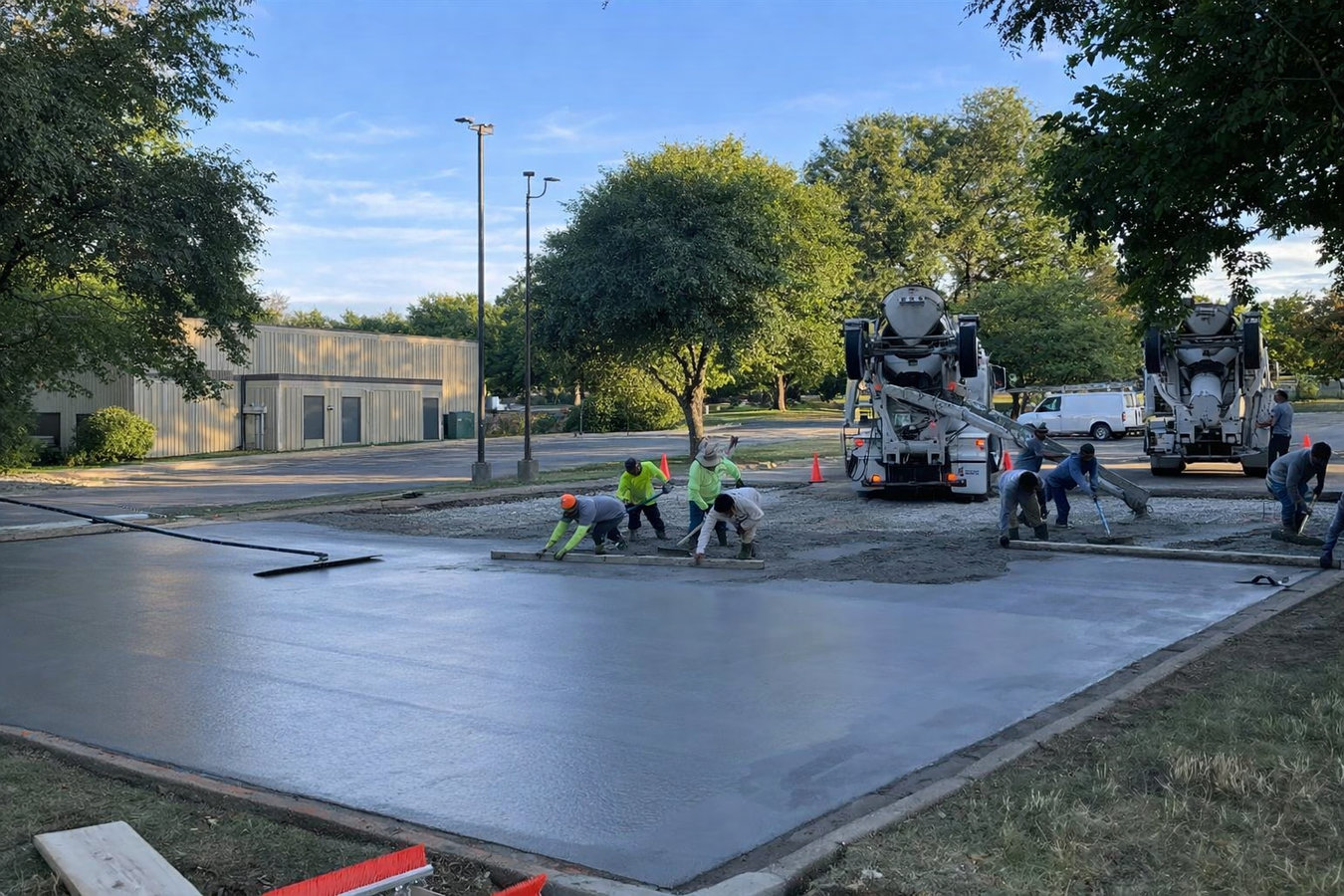
Concrete parking lot building in Portland, ME means removing the existing surface, grading and compacting a crushed-stone base, pouring a 4 to 6 inch concrete slab with control joints, and designing the slope so water drains off - most residential lots take three to six days of active work plus a seven-day curing period before vehicles can return.
A concrete lot is not a surface coating - the work goes several inches deep, which is why it outlasts asphalt or gravel by decades when done correctly. Homeowners in Portland often reach us after years of patching a surface that has cracked, heaved, or turned soft in mud season. Concrete parking lot building in Portland requires city permits for impervious surfaces, and the drainage design has to meet the city stormwater rules - both things we handle as part of the project, not as extras.
If your property also needs a new approach or the parking connects to your home, our concrete driveway building service can be scoped alongside the parking lot so the two surfaces tie together cleanly and drain properly as a system.
If you see cracks that have grown wider each spring, or sections of pavement that have lifted or tilted, that is the freeze-thaw cycle doing its work. Portland averages more than 40 freeze-thaw cycles per year, and damage compounds year over year. Patching buys time, but at some point replacement is the more cost-effective answer.
Puddles that take hours to drain after a storm mean the drainage design of your current surface has failed. In Portland's climate, standing water is a countdown clock - every time it freezes overnight and thaws the next afternoon, it works its way deeper into whatever surface is underneath, accelerating the damage from the inside out.
Many older Portland properties still have gravel or packed-dirt parking areas that become unusable for weeks every spring as the ground thaws. If yours fits that description, a concrete lot solves the problem permanently and adds real value to the property - no more ruts, no more mud, no more waiting for the ground to firm back up.
Scaling - where the top layer flakes off in thin sheets - is a common sign that a previous surface was not built to handle Portland winters. Once scaling starts, it accelerates. If the edges of your parking area are crumbling or the surface looks like it is peeling, the underlying structure has been compromised and repeated patching will not fix the root problem.
We handle residential and small commercial parking lots from first permit application through final walkthrough. Every project starts with a site visit to assess soil conditions, drainage, equipment access, and whether any existing surface needs to come out first. Base preparation - compacted crushed stone at the correct depth - gets as much attention as the pour itself, because it is what determines how the concrete holds up over Portland winters. We cut control joints to give the slab planned flex points, and we grade the surface so water runs off toward a drain or planted buffer rather than pooling. When the lot needs structural support underneath or a post is going in nearby, our concrete footings service can be scoped into the same project phase.
We also handle the full permitting process with the City of Portland - including the stormwater review that applies to new impervious surfaces. You do not have to navigate city requirements yourself. For properties where the parking lot connects to the street or to a home entry, we can tie the lot into existing concrete work so everything drains as a unified system.
Suited for homeowners replacing a gravel, dirt, or deteriorated asphalt parking area on a single-family or multi-family property.
Suited for properties with an existing cracked or heaved surface that needs full removal and replacement rather than patching.
Suited for properties adding off-street parking for the first time, including permits, drainage design, and stormwater compliance.
Suited for flat or low-lying properties where standing water is a recurring problem, requiring cross-slope grading and drain integration as part of the build.
Portland averages more than 40 freeze-thaw cycles per year, and that cycle is the single biggest threat to any paved surface. Water finds its way into small cracks, freezes and expands overnight, and makes those cracks bigger. A parking lot built with shortcuts - thin concrete, inadequate base, poor drainage - will show the damage within two or three winters, not twenty. Portland also has active stormwater rules: any new paved surface is considered impervious and triggers a review of how runoff will be managed. That is not a reason to avoid the project, but it is a reason to work with a contractor who has done this permitting in Portland before. Parts of the city near Back Cove and the waterfront also sit on fill or marine clay soils that compress more than the rock found in higher neighborhoods - soil conditions that have to be assessed before the base is built.
Portland neighborhoods like the West End and Westbrook often have narrow lots with mature trees, old utility lines, and tight street access that affects how equipment gets in and where concrete trucks can park. In established areas like South Portland, the construction season is short and contractors book up fast in spring, so reaching out in late winter gives you the best chance of getting on the schedule before the busy season closes out.
We schedule a site visit - usually within one business day of your call - to look at the ground conditions, drainage, and equipment access. The written estimate you receive after that visit accounts for your specific site, so the number you agree to is the number you pay.
We submit the permit application to the City of Portland and handle the stormwater review. Permit approval typically takes one to three weeks. Once approved, you are placed on our schedule - spring bookings fill fast, so early contact matters.
We remove the existing surface or vegetation, grade the ground to the correct slope for drainage, compact the soil, and install a crushed-stone base layer. This prep phase often takes a full day and is the part of the job that determines how long the concrete holds up.
Concrete is delivered by truck and poured in a single day. We cut control joints, finish the surface, and walk the lot with you before leaving. Plan to keep vehicles off for at least seven days - concrete needs that time to harden fully before it can carry load.
Free site visit, written estimate, no obligation. We handle the Portland permits and stormwater review so you do not have to.
(207) 245-9716New impervious surfaces in Portland require city permits and a stormwater review - a step many homeowners do not expect. We submit the application, respond to city questions, and design the drainage to meet Portland standards the first time, so the project does not stall waiting for corrections.
Portland sees more than 40 freeze-thaw cycles per year. Our base preparation spec - compacted soil, correct gravel depth, and proper drainage slope - is designed for that reality, not for a warmer climate. Lots built with the right base hold up through decades of Maine winters without cracking or heaving.
Portland neighborhoods like Woodfords Corner and the West End have narrow lots, mature trees, and streets that can complicate equipment access. We assess access before quoting, so the price you receive accounts for the actual conditions on your property - not an idealized site plan.
We visit your site before we give you a number. Soil conditions, drainage needs, and site access all affect cost in ways that cannot be assessed from a conversation. The written estimate you receive after the site visit is the number you can rely on - not a starting point for negotiation. For guidance on best practices in concrete pavement, the American Concrete Pavement Association publishes homeowner-facing installation and maintenance resources.
Every parking lot we build in Portland goes through the same process: site assessment, permit management, verified base preparation, and a final walkthrough before we leave. That process is what separates a lot that holds up through Portland winters from one that starts cracking within a few years.
Footings are the structural base required under posts, walls, and any new structure adjacent to a parking area - often scoped in the same project.
Learn moreWhen a parking lot connects to or replaces an existing driveway, concrete driveway building addresses the approach and entry surface as a continuous system.
Learn morePortland's concrete season is short and books up fast - reaching out now means your project can start when the ground is ready, not months later.